Comets vs Meteors: 8 Key Differences You Should Know
Understanding Celestial Bodies: The Basics
Our solar system is home to numerous objects ranging from planets and moons to asteroids and dust particles. Among these diverse celestial bodies, comets and meteors hold a special place in both scientific research and public imagination. Their dramatic appearances have inspired myths, legends, and scientific curiosity throughout human history.
Before diving into the differences, it's important to clarify what these objects actually are. A comet is essentially a cosmic iceberg—a frozen mixture of ice, gases, rock, and dust that orbits the Sun. When this frozen wanderer approaches the Sun, the heat causes its ice to vaporize, creating the characteristic tail that can stretch for millions of miles.
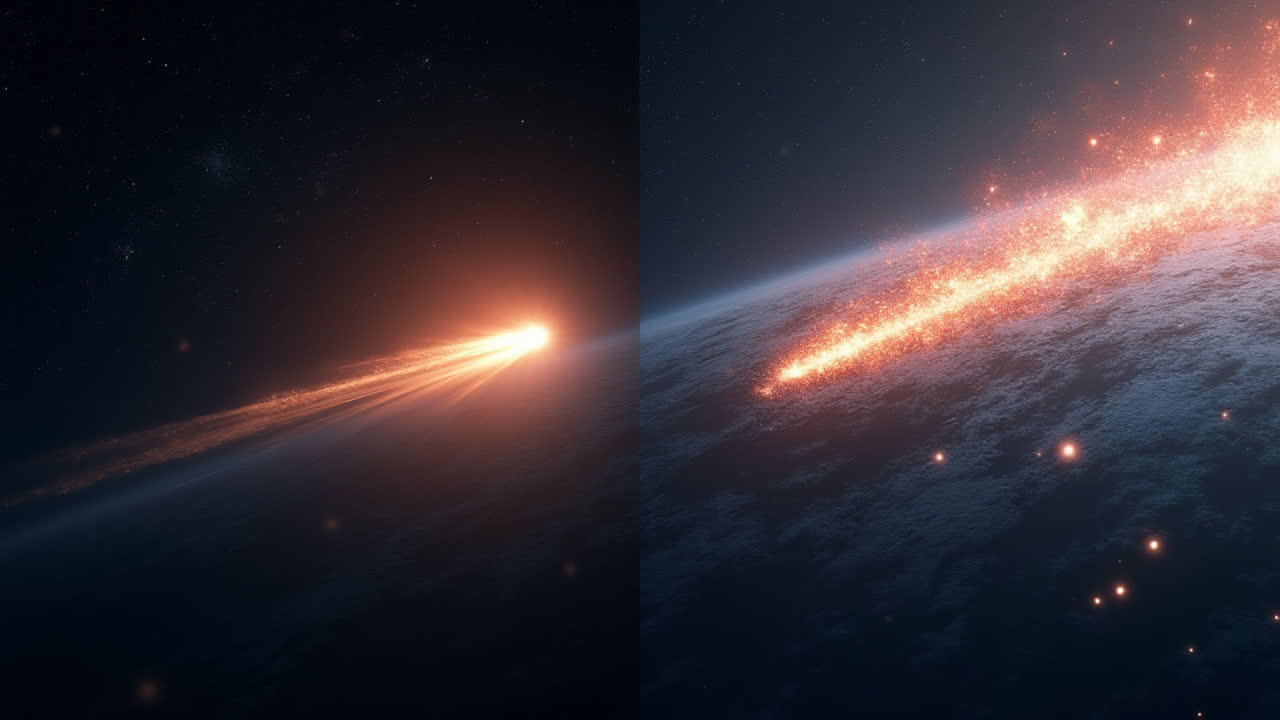
On the other hand, a meteor is what happens when a small piece of rock or debris (called a meteoroid) enters Earth's atmosphere and burns up due to friction. This burning process creates the streak of light we sometimes call a "shooting star"—though it has nothing to do with actual stars! It's simply the visible path of a meteoroid as it vaporizes in our atmosphere.
Have you ever wondered why some night sky events capture our attention more than others? The answer lies partly in the dramatic visual display these objects create. When a comet develops its glowing coma and tail, it can remain visible for weeks or even months. Meteors, meanwhile, offer brief but spectacular flashes that last only seconds—blink and you might miss them!
What Is a Comet? The "Dirty Snowball" of Space
Comets are fascinating cosmic objects made primarily of ice, gases, rock, and dust that orbit the Sun in elongated paths. The core of a comet, known as the nucleus, typically spans a few miles in diameter and consists mainly of frozen materials. According to NASA's research, while water ice forms a significant portion of this frozen core, it also contains other substances like carbon dioxide, carbon monoxide, ammonia, and methane—essentially making comets complex chemical repositories traveling through space.
What makes comets truly remarkable is their transformation as they approach the Sun. When a comet's orbit brings it closer to our star, the frozen nucleus begins to heat up, triggering a process called sublimation where ice turns directly into gas. This released gas carries dust particles with it, forming an enormous glowing envelope around the nucleus called a coma. The spectacle doesn't end there—as solar radiation and solar wind interact with this material, they push it away from the Sun, creating the iconic tails that make comets so distinctive.
Interestingly, comets actually develop two different types of tails: a dust tail composed of tiny particles that reflects sunlight, and an ion tail made of electrically charged molecules that glow in a process similar to how neon signs work. Both tails always point away from the Sun, regardless of which direction the comet is moving, sometimes stretching tens of millions of miles through space.
While our solar system contains countless comets, most remain invisible to the naked eye. They typically reside in distant regions like the Kuiper Belt beyond Neptune and the theorized Oort Cloud at the solar system's edge. Only when their orbital paths bring them closer to the Sun do some become bright enough for us to see without telescopes. Famous examples like Halley's Comet and Comet Hale-Bopp have created spectacular celestial displays during their approaches to Earth, captivating observers throughout recorded history.
What Is a Meteor? The "Shooting Star" Phenomenon
Despite their common nickname of "shooting stars," meteors have nothing to do with stars at all. A meteor is actually the visible streak of light that appears when a meteoroid—a small piece of rock or debris in space—enters Earth's atmosphere at tremendous speed. These cosmic travelers can originate from various sources, including fragments of asteroids or debris left behind by comets as they orbit the Sun.
The journey of a meteor begins when a meteoroid, typically ranging from the size of a grain of sand to a small pebble, encounters Earth's atmosphere while traveling at speeds between 25,000 to 160,000 miles per hour. At such incredible velocities, the friction between the meteoroid and air molecules generates intense heat, causing the meteoroid's outer layers to vaporize. This process creates the luminous trail we observe from Earth's surface—a meteor!
Most meteors completely disintegrate about 50 to 75 miles above Earth's surface, turning to dust that eventually settles to the ground. However, in rare cases, particularly large meteoroids might survive their fiery journey through the atmosphere. Any piece that reaches Earth's surface is called a meteorite, and these space rocks provide scientists with valuable samples of material from beyond our planet.
One of the most exciting aspects of meteor observation occurs during meteor showers—events where Earth passes through the debris trail left by a comet. During these celestial shows, dozens or even hundreds of meteors may become visible per hour, creating spectacular displays like the annual Perseids or Leonids. These regular meteor showers happen at predictable times each year, allowing space enthusiasts to plan their viewing in advance.
Unlike comets, which we might observe when they're millions of miles away, meteors only become visible when they're already in Earth's atmosphere—usually less than 100 miles above us. This proximity is one key difference between these two fascinating space phenomena.
Comprehensive Comparison: Comets vs Meteors
While both comets and meteors create stunning displays in our skies, they differ in numerous important ways. Understanding these differences helps us appreciate the unique nature of each phenomenon and recognize what we're actually seeing when we observe them. The following comparison highlights the most significant distinctions between these celestial objects:
| Feature | Comets | Meteors |
|---|---|---|
| Composition | Primarily ice, gases, rock, and dust ("dirty snowballs") | Small pieces of rock or metal (meteoroids) that enter Earth's atmosphere |
| Location when visible | Can be visible when millions of miles from Earth | Only visible when in Earth's atmosphere (typically 50-75 miles above surface) |
| Duration of visibility | Can remain visible for weeks or months | Visible for only a few seconds |
| Appearance | Bright nucleus with glowing coma and tail(s) | Streak of light ("shooting star") |
| Origin | Formed in the early solar system, often from Oort Cloud or Kuiper Belt | Often debris from comets or fragments from asteroid collisions |
| Viewing equipment | Many require telescopes to see; larger ones visible to naked eye | Best viewed with naked eye; no telescope needed |
| Predictability | Some have predictable orbits (like Halley's Comet); others are one-time visitors | Meteor showers occur at predictable times annually when Earth passes through comet debris |
| Size | Nucleus typically a few miles in diameter; coma can be larger than planets | Usually tiny (grain of sand to pebble size) before burning up |
The Fascinating Connection Between Comets and Meteors
While we've explored how comets and meteors differ, they actually share an interesting relationship that creates one of the night sky's most anticipated events: meteor showers. This connection demonstrates the complex interactions between different celestial bodies in our solar system.
As comets orbit the Sun, they leave behind trails of debris—small pieces of dust and rock that continue to follow similar orbital paths. When Earth's orbit intersects these debris trails, the particles enter our atmosphere as meteoroids and create meteors. Essentially, many of the "shooting stars" we observe during major meteor showers are tiny pieces of comets burning up in our atmosphere!
This relationship explains why many meteor showers occur at predictable times each year. For example, the Perseid meteor shower in August happens when Earth passes through the debris trail of Comet Swift-Tuttle, while the December Geminids originate from an unusual asteroid-like object called 3200 Phaethon. By understanding the parent objects of various meteor showers, astronomers can predict not only when these displays will occur but also their intensity based on how recently the parent comet passed through that section of the orbit.
I once watched the Perseids meteor shower from a dark field away from city lights, and the experience was truly magical. Dozens of meteors streaked across the sky each hour, and realizing that each flash represented a tiny piece of a comet that had been wandering our solar system for thousands or millions of years made the show even more meaningful. These cosmic connections remind us how interlinked the seemingly separate objects in our solar system actually are.
Observing Tips: How to Spot Comets and Meteors
Witnessing these celestial phenomena can be a thrilling experience, but it helps to know when and how to look for them. While meteors appear suddenly and without warning (except during predicted meteor showers), comets often provide longer viewing windows once discovered. Here are some practical tips for observing both:
Comet Viewing Tips
- Stay informed about newly discovered comets through astronomy websites and apps
- Use binoculars or a small telescope for better viewing, especially for fainter comets
- Look in the direction specified by astronomy reports, usually related to constellations
- The best time is often just after sunset or before sunrise when the sky is dark but the comet is near the horizon
- Find locations away from city lights for better visibility
- Be patient—comets move slowly from night to night
Meteor Viewing Tips
- Check astronomical calendars for major meteor shower dates
- Choose viewing locations with minimal light pollution
- No equipment needed—the naked eye works best for meteor spotting
- Look toward the shower's radiant point, but also scan the surrounding sky
- The peak viewing time is typically between midnight and dawn
- Allow 20-30 minutes for your eyes to fully adapt to darkness
- Use a reclining chair or blanket for comfort during extended viewing
- Be prepared for variable conditions—some showers are more spectacular than others
Have you ever considered planning a trip specifically around a meteor shower or comet appearance? Many astronomy enthusiasts organize "star parties" or camping trips to coincide with these events, creating memorable experiences that combine nature appreciation with celestial observation. With proper planning, even beginners can enjoy these cosmic displays!
Frequently Asked Questions About Comets and Meteors
Can meteors hit the Earth and cause damage?
Yes, although it's relatively rare for significant damage to occur. Most meteors burn up completely in the atmosphere, but larger objects can survive as meteorites and reach Earth's surface. While small meteorites typically cause no harm, larger impacts have occurred throughout Earth's history. The most famous example is the Chicxulub impact about 66 million years ago, which created a 110-mile wide crater and likely contributed to the extinction of non-avian dinosaurs. More recently, the 2013 Chelyabinsk meteor explosion over Russia injured about 1,500 people, primarily from broken glass caused by the shock wave. Scientists continuously monitor potentially hazardous asteroids to provide early warnings of possible impacts.
How many comets are there in our solar system?
The exact number is unknown, but astronomers estimate there could be billions of comets in our solar system. Most reside in two main regions: the Kuiper Belt beyond Neptune's orbit (home to short-period comets that orbit the Sun in less than 200 years) and the much more distant Oort Cloud (source of long-period comets with orbital periods of thousands or millions of years). Despite these vast numbers, only a small fraction of comets ever come close enough to the Sun to become visible from Earth. Astronomers have cataloged approximately 3,700 known comets as of now, but this represents just a tiny percentage of the total population. New comets continue to be discovered regularly, especially with advanced survey telescopes designed to scan large portions of the sky.
What is the difference between a meteor, meteoroid, and meteorite?
These three terms refer to the same object at different stages of its journey: A meteoroid is the original space rock or particle traveling through space, typically ranging from tiny dust grains to boulder-sized objects. When a meteoroid enters Earth's atmosphere and begins to burn up, creating the streak of light we see, it becomes a meteor (often called a "shooting star"). If any portion of the object survives the journey through the atmosphere and lands on Earth's surface, that remaining piece is called a meteorite. Think of it this way: the object is a meteoroid in space, a meteor in our atmosphere, and a meteorite if it reaches the ground. Most meteoroids completely vaporize in the atmosphere, which is why meteorites are relatively rare compared to the number of meteors observed.
Conclusion: Cosmic Wonders Worth Watching
The distinction between comets and meteors illustrates the fascinating diversity of objects in our solar system. While comets are distant, icy bodies that orbit the Sun and develop glowing tails when they approach our star, meteors are the brief flashes of light we see when small particles enter and burn up in Earth's atmosphere. The primary difference lies in their composition, location, and duration of visibility—comets can be observed far from Earth for extended periods, while meteors appear only momentarily within our atmosphere.
Despite these differences, both phenomena continue to captivate human imagination and drive scientific inquiry. From ancient civilizations that saw comets as omens to modern astronomers using meteor compositions to understand the early solar system, these celestial events connect us to the greater cosmos in meaningful ways.
The next time you glimpse a streak of light across the night sky or hear news of an approaching comet, you'll have a deeper understanding of exactly what you're observing. Whether it's the ephemeral beauty of a meteor shower or the stately progress of a comet, these cosmic visitors invite us to look up, wonder, and appreciate our place in an incredible universe. So grab a blanket, find a dark spot away from city lights, and give yourself the gift of witnessing these spectacular celestial displays firsthand!