Hors d'oeuvres vs Canapes: Understanding the Key Differences
Have you ever been to a fancy cocktail party and wondered what exactly you were eating? Those delightful little bites might have been hors d'oeuvres or canapes – but what's the difference? While these terms are often used interchangeably, they're not quite the same thing. The main distinction is that while all canapes are hors d'oeuvres, not all hors d'oeuvres are canapes. Confusing, right? Let's dive into the delicious world of these sophisticated appetizers and clear things up once and for all.
If you're planning a cocktail party or just want to impress your foodie friends with some culinary knowledge, understanding the difference between these two popular appetizers is essential. In this comprehensive guide, I'll walk you through everything you need to know about gourmet finger foods, from their definitions and origins to preparation techniques and perfect serving occasions.
What Are Hors d'oeuvres? A Comprehensive Definition
The term "hors d'oeuvres" comes from French, literally meaning "outside the work" or "outside the main dish." These are small, savory food items served before a meal, typically during a cocktail hour. I remember attending my first upscale event where servers circulated with trays of these delectable bites – it was quite the experience trying to balance my cocktail while gracefully eating something that required no utensils!
Hors d'oeuvres are designed to be eaten with your fingers and are usually consumed in one or two bites. They're meant to stimulate the appetite without filling you up before the main course. These sophisticated nibbles can be hot or cold and come in countless varieties. Some classic examples include stuffed mushrooms, deviled eggs, shrimp cocktail, and yes – canapes.
What makes hors d'oeuvres distinct from regular appetizers? While people often use these terms interchangeably, there's a subtle difference. Appetizers are typically the first course of a seated meal, while hors d'oeuvres are usually served separately from the meal, often at a cocktail party or reception where guests may be standing. They're designed to be easier to eat while mingling, without requiring utensils or a place to sit down.
The variety of hors d'oeuvres is truly impressive. They can range from simple items like olives or nuts to more elaborate creations requiring significant preparation. Some common types include:
- Crudités – raw vegetables served with dip
- Meat kebabs – small skewers with meat and sometimes vegetables
- Antipasto – assortments of cured meats, cheeses, and marinated vegetables
- Bruschetta – grilled bread rubbed with garlic and topped with various ingredients
- Mini quiches – small savory egg-based tarts
- Stuffed pastries – like samosas or empanadas
- Canapes – which we'll discuss in detail next
Canapes Explained: Structure and Characteristics
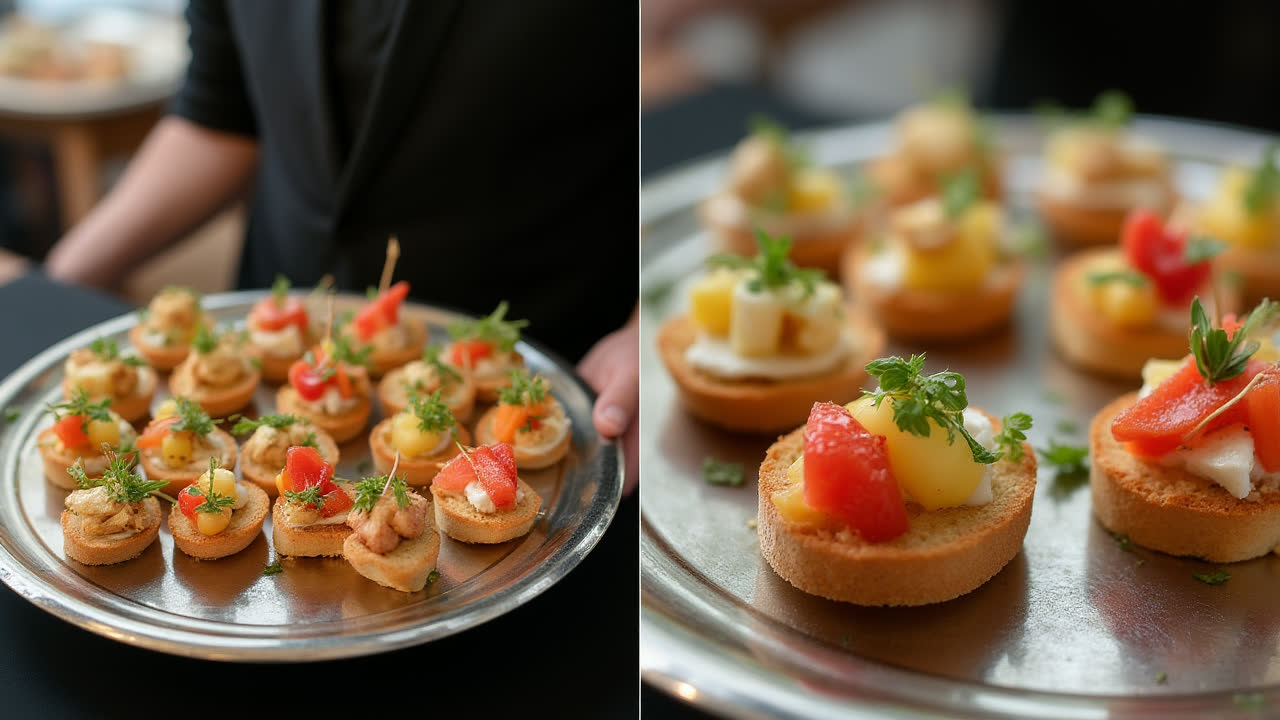
Canapes represent a specific subset of hors d'oeuvres with a distinctive structure. The word "canapé" actually means "sofa" in French, which is a cute way to think about these appetizers – the base is like a little sofa for the toppings to sit on! I once tried making these for a dinner party and quickly realized there's quite an art to balancing the ingredients so they don't topple over when guests pick them up.
What makes canapes unique is their structured, layered composition. They typically consist of four main components:
- Base: A small piece of bread, toast, cracker, or pastry shell that serves as the foundation
- Spread: A layer of butter, flavored cream cheese, mayonnaise, or another spread that adds moisture and acts as "glue"
- Topping: The main ingredient – could be seafood, meat, cheese, vegetables, or a combination
- Garnish: A decorative and flavorful finishing touch, like herbs, caviar, or a small vegetable slice
This structured approach is what distinguishes canapes from other types of hors d'oeuvres. While other finger foods might be more freeform in their composition, canapes follow this specific layered pattern. They're also typically quite small – often just a single bite – making them perfect for elegant occasions where guests want to sample multiple offerings without filling up.
The presentation of canapes is also noteworthy. They're usually arranged artfully on serving platters, with attention paid to color, texture, and overall visual appeal. In high-end catering, you'll often see stunning geometric arrangements or creative patterns forming a true edible art piece. This emphasis on presentation is particularly associated with canapes compared to some other, more rustic forms of hors d'oeuvres.
Historical Origins: How These Appetizers Evolved
The history of these small bites is quite fascinating. Hors d'oeuvres have been around in some form since ancient times, but they gained particular prominence in France during the 19th century. The concept of serving small, flavorful bites before a meal has roots in many culinary traditions around the world, from Spanish tapas to Chinese dim sum. But it was French culinary tradition that formalized the concept and gave us the term "hors d'oeuvres."
Canapes, as a specific type of hors d'oeuvre, evolved a bit later. They became particularly popular in the early 20th century, especially during the cocktail party boom of the 1920s. During Prohibition in America, these small bites became essential companions to cocktails, helping to mask the sometimes harsh taste of bootleg liquor! I can't help but imagine those glamorous speakeasy gatherings with trays of elaborately decorated tiny toasts making the rounds.
The evolution of both hors d'oeuvres and canapes has been influenced by global culinary trends. What began as simple bread with toppings has expanded to include influences from cuisines worldwide. Modern canapes might feature ingredients like wasabi, harissa, or chimichurri that would have been unimaginable to their 19th-century inventors.
It's also worth noting that the formality associated with these appetizers has shifted over time. While they were once exclusively associated with high-end dining and formal occasions, today's interpretations can range from extremely elegant to casual and approachable. You might find sophisticated canapes at a wedding reception, but also encounter more relaxed versions at a neighborhood potluck – that's the wonderful versatility of these appetizer formats!
Detailed Comparison: Hors d'oeuvres vs Canapes
| Comparison Factor | Hors d'oeuvres | Canapes |
|---|---|---|
| Definition | Small savory dishes served before meals, usually with cocktails | A specific type of hors d'oeuvre with a base, spread, topping, and garnish |
| Structure | Varied structures - can be anything from skewered items to stuffed vegetables | Always has a specific layered structure with a base, spread, topping, and garnish |
| Base | May or may not have a bread/cracker base | Always has a base of bread, toast, cracker, or pastry |
| Preparation Complexity | Can range from simple to complex | Typically requires more assembly and attention to detail |
| Variety | Includes many types: crudités, skewers, stuffed items, dips, etc. | Limited to the specific canape format but with endless topping variations |
| Serving Style | Can be served on platters, passed trays, or buffet style | Usually served on platters or passed trays, often arranged decoratively |
| Formality Level | Can range from casual to formal depending on the type | Typically associated with more formal or elegant occasions |
| Relationship | All canapes are hors d'oeuvres | Not all hors d'oeuvres are canapes |
When and How to Serve: Perfect Occasions
Knowing when and how to serve these delightful appetizers can make a big difference in your hosting game. Hors d'oeuvres, including canapes, are traditionally served during what the French call "l'heure de l'apéritif" – the time for an aperitif or pre-dinner drink. In American entertaining, we typically call this the cocktail hour.
For formal events, such as weddings or corporate galas, both hors d'oeuvres and canapes can be appropriate. However, canapes tend to have an air of extra elegance that makes them particularly suited to high-end occasions. Their precise construction and often artistic presentation signal a special event. I once attended a gallery opening where the canapes were designed to visually echo the artwork – it was such a clever touch that elevated the entire experience!
For more casual gatherings, you might lean toward simpler forms of hors d'oeuvres. Things like a charcuterie board, vegetable crudités with dip, or stuffed mushrooms provide that same finger-food convenience without the fussiness of precisely constructed canapes. The beauty of hors d'oeuvres is their flexibility – you can match the formality level to your event.
When it comes to serving, there are three main approaches:
- Passed service: Servers circulate with trays, offering items to guests
- Stationary displays: Food is arranged on tables where guests can help themselves
- Combination approach: Some items are passed while others are stationary
The number of different hors d'oeuvres or canapes to offer depends on your event length and whether a meal will follow. For a cocktail-only event lasting 2-3 hours, a good rule of thumb is 5-8 different types, with enough pieces for each guest to have 2-3 of each type. If dinner follows, you can reduce this to 3-5 different types, with 2-3 pieces per person.
DIY Guide: Creating Your Own Impressive Appetizers
Want to try your hand at making these sophisticated nibbles? Let's start with some basics for creating your own impressive hors d'oeuvres and canapes. I've learned through plenty of trial and error that the key is preparation – having everything ready to assemble means you won't be stuck in the kitchen while your guests are arriving!
For canapes specifically, remember the four-part structure: base, spread, topping, and garnish. Here's a simple formula you can adapt endlessly:
- Base options: Toasted baguette slices, melba toast, crackers, small pastry shells, cucumber rounds
- Spread ideas: Herb butter, cream cheese (plain or flavored), hummus, aioli, high-quality mayonnaise
- Topping suggestions: Smoked salmon, prosciutto, roast beef, cheese, olive tapenade, roasted peppers
- Garnish possibilities: Fresh herbs, capers, tiny cornichons, caviar, edible flowers, microgreens
When making canapes, size matters. The ideal canape is small enough to eat in one bite – no larger than 1.5 inches across. This prevents the awkward situation of having a half-eaten canape and nowhere to put it. Cut your bases accordingly and keep toppings proportional.
For broader hors d'oeuvres ideas, think about incorporating variety in your selection. Aim for a mix of:
- Different temperatures (some hot, some cold)
- Various main ingredients (meat, seafood, vegetable, cheese)
- Range of flavors (savory, spicy, sweet-savory)
- Diverse textures (crispy, creamy, tender)
Remember that presentation elevates even simple offerings. Invest in some nice serving platters, use fresh garnishes like herb sprigs or citrus zest, and arrange items thoughtfully rather than just piling them on. Sometimes I like to place food on unexpected serving pieces – like individual spoons for a single bite or miniature glasses for tiny portions of soup.
Finally, don't forget practicality. The best hors d'oeuvres and canapes maintain their quality at room temperature for at least an hour and don't require utensils to eat. Your guests will appreciate being able to mingle without wrestling with their food!
Frequently Asked Questions
Can I prepare hors d'oeuvres or canapes in advance?
Absolutely! Many hors d'oeuvres and canapes can be prepared partially or completely in advance, which is one of their advantages for entertaining. For canapes specifically, you can often prepare the bases and spreads a day ahead, then assemble shortly before serving. Some heartier hors d'oeuvres like stuffed mushrooms can be assembled completely and refrigerated before baking. Just be careful with ingredients that might make bread bases soggy – for these, it's best to assemble closer to serving time. I typically prep everything the morning of an event, then do final assembly about an hour before guests arrive.
What's the proper serving size for hors d'oeuvres and canapes?
The ideal serving size depends on your event type, but generally, hors d'oeuvres and canapes should be bite-sized or two-bite portions at most. For canapes, a base of about 1.5 inches across is standard. When calculating quantities, consider whether your event is a cocktail party (more hors d'oeuvres needed) or pre-dinner reception (fewer needed). For a cocktail-only event lasting 2-3 hours, plan for 12-15 pieces per person. If dinner follows, 5-7 pieces per person is usually sufficient. It's always better to have slightly too many than too few – you can always enjoy the leftovers yourself the next day!
Are there vegetarian and vegan options for canapes and hors d'oeuvres?
Definitely! There are countless delicious vegetarian and vegan options for both hors d'oeuvres and canapes. For vegetarian canapes, consider bases topped with herbed goat cheese and roasted vegetables, or crostini with brie and fruit compote. Vegan options might include cucumber rounds with hummus and olive tapenade, or toast points with avocado and roasted tomatoes. Beyond canapes, vegetarian hors d'oeuvres like stuffed mushrooms, vegetable skewers, or falafel bites are always crowd-pleasers. When planning your menu, I recommend making at least 30-40% of your offerings vegetarian or vegan to accommodate different dietary preferences. In my experience, these plant-based options often disappear first at parties – they're that good!
Conclusion: The Art of Small Bites
Understanding the difference between hors d'oeuvres and canapes might seem like a small detail, but it's these little nuances that can elevate your culinary knowledge and hosting skills. To recap: hors d'oeuvres are the broader category of small savory bites served with drinks, typically before a meal. Canapes are a specific type of hors d'oeuvre with a structured, layered approach – always featuring a base, spread, topping, and garnish.
Whether you're planning an elegant cocktail party, a casual gathering with friends, or just expanding your food vocabulary, these sophisticated small bites have a special place in culinary tradition. They represent the beautiful intersection of practicality (being easy to eat while mingling) and artistry (offering endless creative possibilities).
What's your favorite type of hors d'oeuvre? Have you tried making canapes at home? The world of small bites is vast and delicious – there's always something new to discover and enjoy. So next time you're at a fancy event or planning your own gathering, you'll know exactly what you're serving or being served. And that bit of knowledge might just make everything taste even better!