Understanding Magnetism vs Electromagnetism: Key Differences Explained
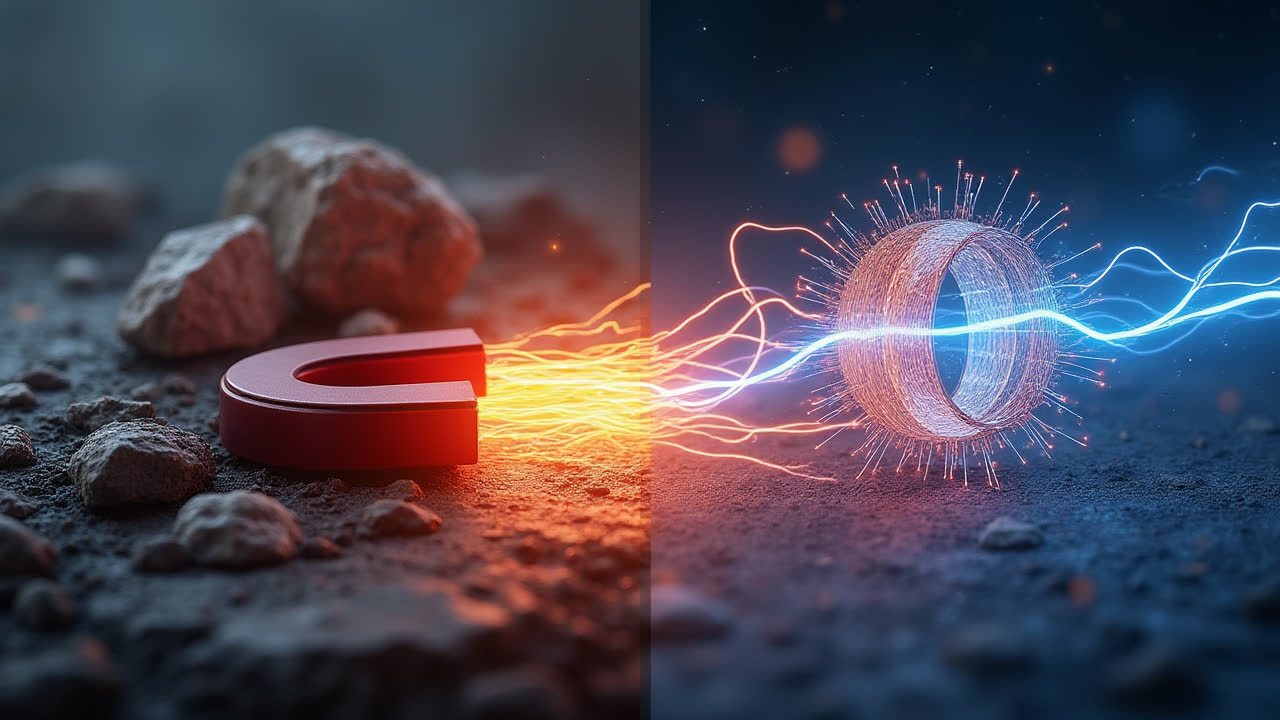
Have you ever wondered about the invisible forces that power our modern world? From the compass that guides explorers to the electric motors driving our vehicles, magnetism and electromagnetism are fundamental forces that shape our technological landscape. While these terms are often used interchangeably, they represent distinct yet interconnected concepts in physics. This article explores the fascinating differences between these forces, their properties, and their applications.
When I first started studying physics, I found these concepts particularly challenging to grasp. The way these invisible forces interact with our world seemed almost magical! But understanding the distinction between them is crucial for anyone interested in the sciences or engineering. Let's dive into the world of magnetic fields and electromagnetic forces to unravel their mysteries.
The main difference between magnetism and electromagnetism is straightforward: magnetism refers specifically to phenomena caused by magnetic forces alone, while electromagnetism encompasses phenomena resulting from both magnetic and electric forces. This distinction, though simple, has profound implications for how we understand and harness these forces in our daily lives.
What is Magnetism: Understanding the Basics
Magnetism describes any phenomenon attributable to a magnetic field. We're all familiar with magnets - those curious objects that can attract or repel each other without touching. A magnetic field is a region where magnetic materials experience a force. This invisible field extends around magnets, creating what scientists call "action at a distance" - forces that work without physical contact.
One of the most fascinating aspects of magnets is their poles, commonly known as "north poles" and "south poles." These poles follow a simple but important rule: like poles repel each other (north-north or south-south), while unlike poles attract (north-south). Interestingly, magnetic poles never exist in isolation - a north pole is always accompanied by a south pole. No matter how many times you cut a magnet in half, each piece will always have both a north and south pole.
But where does magnetism come from at the atomic level? The answer lies in a property of electrons called "spin." Now, this isn't actually physical spinning (though the name might suggest that), but rather a quantum mechanical property that behaves mathematically similar to spinning objects in classical physics. This spin gives electrons a property called magnetic moment - essentially making each electron act like a tiny magnet.
In most materials, the magnetic moments of electrons point in random directions, effectively canceling each other out. However, in magnetized materials, something special happens: these magnetic moments align in the same direction. When enough electrons line up their magnetic moments, their combined effect becomes strong enough for us to detect as magnetism.
When you place a material inside a magnetic field, something remarkable happens. The external field can cause the magnetic moments of electrons in the material's atoms to align, resulting in the material becoming magnetized. The degree of magnetization depends on both the material type and the strength of the external magnetic field. Some materials, like iron, retain this alignment even after the external field is removed, becoming what we call permanent magnets.
What is Electromagnetism: The Unified Force
Electromagnetism encompasses a broader range of phenomena than magnetism alone. It describes all phenomena attributed to either electric or magnetic forces. What makes electromagnetism particularly significant in physics is the profound realization that electric and magnetic fields are actually interrelated - different aspects of a single electromagnetic force.
The story of how scientists discovered this connection is one of the most fascinating chapters in the history of physics. Before the 1820s, electricity and magnetism were studied as completely separate phenomena. Scientists had conducted various experiments with static electricity, batteries, and magnets, but no one had established a clear link between these forces.
The breakthrough came in 1820 when Danish physicist Hans Christian Ørsted made a remarkable observation during a lecture. He noticed that when a compass was brought near a wire carrying an electric current, the compass needle deflected. This simple observation was revolutionary - it provided the first clear evidence that electricity and magnetism were somehow connected. Ørsted had discovered that an electric current generates a magnetic field around it.
This discovery quickly led to practical applications. By coiling a wire and passing an electric current through it, scientists created electromagnets - devices that could be turned on and off, unlike permanent magnets. Today, electromagnets are everywhere - from simple doorbells to powerful MRI machines and the enormous magnets used in particle accelerators.
Following Ørsted's discovery, other scientists began exploring the relationship between electricity and magnetism more deeply. They discovered that two current-carrying conductors exert forces on each other when placed close together. The French physicist André Ampère developed equations describing these forces in terms of the current flowing through the conductors.
In the 1830s, English scientist Michael Faraday made another groundbreaking discovery. He found that a changing magnetic field could induce an electric current in a nearby conductor. He demonstrated this in two ways: by moving a permanent magnet near a coiled conductor and by changing the current in one conductor to induce current in another nearby conductor. This principle of electromagnetic induction forms the basis of electric generators, transformers, and countless other devices that power our modern world.
The theoretical unification of electricity and magnetism came in the 1860s with James Clerk Maxwell. By combining and extending the ideas of Ampère and Faraday into a set of elegant mathematical equations, Maxwell showed that electricity and magnetism are aspects of a more general underlying phenomenon. His work predicted the existence of electromagnetic waves traveling at the speed of light - leading to the realization that light itself is an electromagnetic wave.
The story didn't end there. With Albert Einstein's special theory of relativity in the early 20th century, scientists gained even deeper insights. Einstein showed that electric and magnetic fields transform into each other depending on the observer's reference frame. What one observer experiences as an electric field, another moving observer might experience partly as a magnetic field!
Comprehensive Comparison: Magnetism vs Electromagnetism
| Aspect | Magnetism | Electromagnetism |
|---|---|---|
| Definition | Phenomena caused solely by magnetic forces | Phenomena caused by both electric and magnetic forces |
| Scope | Narrower, limited to magnetic interactions | Broader, encompasses both electric and magnetic interactions |
| Source | Electron spin and alignment of magnetic moments | Moving electric charges and changing electric/magnetic fields |
| Historical Understanding | Known since ancient times (lodestones) | Connection discovered in 1820 by Ørsted, unified by Maxwell in 1860s |
| Field Generation | Permanent magnets, aligned electron spins | Electric currents, changing electric fields |
| Field Control | Limited, permanent magnets are always "on" | Highly controllable by varying electric current |
| Common Applications | Compasses, refrigerator magnets, magnetic storage | Electric motors, generators, transformers, telecommunications |
| Theoretical Framework | Classical magnetostatics | Maxwell's equations, quantum electrodynamics |
The Evolution of Understanding: From Separate Forces to Unified Theory
The journey from understanding magnetism and electricity as separate forces to recognizing them as aspects of a unified electromagnetic force represents one of the greatest achievements in physics. This unification didn't stop with Maxwell's equations, either. The story continues with even deeper connections being discovered.
In the 1970s, theoretical physicists Sheldon Glashow, Abdus Salam, and Steven Weinberg made another remarkable breakthrough. They demonstrated that at high energy levels, electromagnetic forces behave identically to weak nuclear forces (one of the four fundamental forces responsible for radioactive decay). Their theoretical work was later confirmed by experiments, leading to another unification in physics: the electromagnetic force and the weak force were combined into what we now call the electroweak force.
I remember being completely astounded when I first learned about this progression of understanding. What started as observations of strange stones (lodestones) attracting iron in ancient times had evolved through careful experimentation and brilliant theoretical work into a profound understanding of the fundamental forces that govern our universe. This journey of discovery continues today, as physicists seek to unify the electroweak force with the remaining two fundamental forces: the strong nuclear force and gravity.
The quest for a "Theory of Everything" that would unite all four fundamental forces remains one of the greatest challenges in modern physics. Such a theory would bridge the gap between Einstein's general relativity (which describes gravity) and quantum mechanics (which describes the other three forces). String theory and loop quantum gravity are among the candidates being explored, though a complete unification remains elusive.
Practical Applications in Modern Technology
The theoretical distinction between magnetism and electromagnetism might seem academic, but understanding this difference has enabled countless technological innovations that shape our modern world. Let's explore some practical applications where these forces are harnessed.
Permanent magnets, the domain of "pure" magnetism, find applications in countless devices. From the humble refrigerator magnet to magnetic locks, speakers, headphones, and hard disk drives, these devices rely on the persistent magnetic fields that don't require continuous power input. Magnetic materials are also crucial in magnetic resonance imaging (MRI) machines, though these often use electromagnets rather than permanent magnets.
Electromagnetism, with its controllable nature, powers even more of our technological world. Electric motors convert electrical energy into mechanical motion through electromagnetic interactions. These motors are everywhere - in electric vehicles, washing machines, fans, power tools, and countless other devices. The principle works in reverse too: generators convert mechanical energy into electricity through electromagnetic induction, forming the backbone of our power generation infrastructure.
Transformers, essential components of our electrical grid, use electromagnetic principles to step voltage up or down for efficient power transmission and safe home use. Meanwhile, electromagnetic waves carry our communications - from radio and television broadcasts to Wi-Fi signals and cellular networks. Even the screen you're reading this on likely uses electromagnetic principles in its operation!
The medical field has also benefited enormously from our understanding of these forces. Beyond MRI machines, devices like transcranial magnetic stimulation (TMS) use electromagnetic fields to treat depression and other neurological conditions. Electromagnetic technology also enables wireless charging for devices and induction cooking, which heats cookware directly without flame or heating elements.
Frequently Asked Questions About Magnetism and Electromagnetism
Can magnetism exist without electricity?
Yes, magnetism can exist without a flowing electric current, as seen in permanent magnets like lodestones or refrigerator magnets. These materials have intrinsically aligned electron magnetic moments that create a persistent magnetic field without requiring electricity. However, at the atomic level, magnetism is still related to electric charges (electrons) and their quantum mechanical properties. While macroscopically separate, modern physics reveals that magnetism and electricity are fundamentally interconnected aspects of the electromagnetic force.
Why can't magnetic monopoles be found in nature?
Magnetic monopoles—isolated north or south poles—have never been observed in nature despite extensive searches. This is fundamentally different from electric charges, which can exist as isolated positive or negative charges. According to Maxwell's equations and our current understanding of physics, magnetic field lines always form closed loops without beginnings or ends, meaning poles must always come in pairs. While some theories like grand unified theories and string theory predict their existence, and some condensed matter systems can exhibit monopole-like behavior, true monopoles remain elusive. Their discovery would require revising fundamental aspects of electromagnetic theory.
How did Maxwell unify electricity and magnetism?
James Clerk Maxwell unified electricity and magnetism in the 1860s by developing a set of four elegant mathematical equations that describe how electric and magnetic fields interact and propagate. His groundbreaking insight was adding the "displacement current" term to Ampère's law, completing the symmetry between electricity and magnetism. This addition revealed that changing electric fields create magnetic fields (already known through Faraday's work) and vice versa. Maxwell's equations predicted electromagnetic waves traveling at the speed of light, leading to the realization that light itself is an electromagnetic wave. This mathematical framework demonstrated that electricity and magnetism are not separate phenomena but different aspects of a single electromagnetic force, revolutionizing physics and laying groundwork for technologies from radio to smartphones.
Conclusion: The Unified Understanding of Forces
The distinction between magnetism and electromagnetism represents more than just a semantic difference—it reflects the evolution of our scientific understanding. While magnetism refers specifically to phenomena arising from magnetic fields, electromagnetism encompasses a broader range of phenomena that includes both electric and magnetic forces and their interactions.
This journey from seeing electricity and magnetism as separate forces to understanding them as aspects of a unified electromagnetic force stands as one of the great triumphs in the history of physics. It reminds us how careful observation, experimentation, and mathematical reasoning can reveal the hidden connections that govern our universe.
As we continue to harness these forces in increasingly sophisticated ways—from quantum computers to fusion reactors—the fundamental insights gained by scientists like Ørsted, Faraday, and Maxwell continue to guide our technological development. The story of magnetism and electromagnetism teaches us that what appears distinct on the surface may, with deeper understanding, reveal profound underlying unity.
To summarize: magnetism deals specifically with magnetic forces and their effects, while electromagnetism encompasses both electric and magnetic forces and recognizes them as different aspects of a single electromagnetic force. This unified understanding has not only deepened our theoretical grasp of the universe but also enabled countless technologies that power our modern world.