Telescope vs Microscope: 8 Critical Differences You Should Know
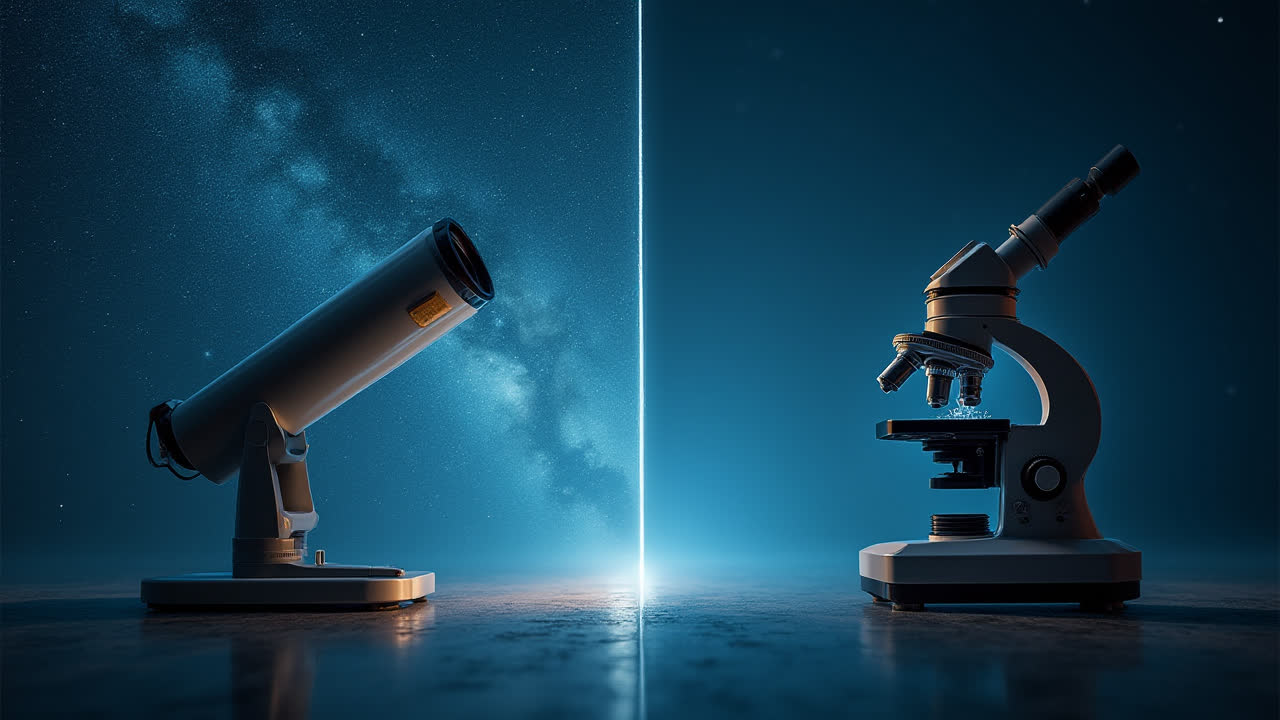
Have you ever wondered about the difference between telescope and microscope instruments that both seem to do similar things—magnify what we can't see with our naked eyes? Despite their apparent similarities, these optical marvels serve completely different purposes and operate on distinct principles. I've been fascinated by both instruments since childhood, and today I'll guide you through everything you need to know about these remarkable devices.
Telescopes and microscopes fundamentally differ in what they help us observe. While telescopes bring distant celestial objects closer to our view, microscopes reveal the hidden miniature world that surrounds us everyday. Both instruments have revolutionized our understanding of the universe—from the cosmic to the microscopic—but they accomplish this through different optical arrangements and principles.
What Are Telescopes: Exploring the Distant Universe
A telescope is an optical instrument designed to make distant objects appear closer, allowing us to observe things far beyond our unaided vision capabilities. The word "telescope" comes from the Greek words "tele" (far) and "skopein" (to look or see), literally meaning "far-seeing." I remember the first time I looked through a telescope at Saturn's rings—it was truly a life-changing moment that sparked my interest in astronomy.
Telescopes collect and focus light from distant objects using either lenses (refracting telescopes) or mirrors (reflecting telescopes). The primary component in a refracting telescope is the objective lens, which gathers light from faraway objects and forms a real, inverted image. The eyepiece then magnifies this image, making it appear larger when you look through it. The basic principle involves two convex lenses working together to magnify distant objects.
Reflecting telescopes, invented by Isaac Newton in the 17th century, use a concave mirror instead of an objective lens. This mirror captures and reflects light to a focal point, where another mirror directs it to an eyepiece. This design helps eliminate chromatic aberration (color distortion) that can occur in refracting telescopes. Today's modern observatories primarily use reflectors because mirrors can be made much larger than lenses, allowing for greater light-gathering capability.
Beyond traditional optical telescopes, scientists now use various specialized telescopes that detect different parts of the electromagnetic spectrum. Radio telescopes, like the impressive Atacama Large Millimeter/submillimeter Array (ALMA), capture radio waves from celestial objects. Other types include X-ray telescopes, gamma-ray telescopes, and infrared telescopes, each providing unique insights into different aspects of our universe. Sometimes I wonder what early astronomers would think if they could see these incredible modern instruments!
Understanding Microscopes: Revealing the Invisible Small World
A microscope is an instrument used to see objects that are too small for the naked eye. The term comes from the Greek words "mikros" (small) and "skopein" (to look or see). Unlike telescopes that bring distant objects closer, microscopes magnify tiny nearby objects. I once spent hours looking at pond water under a microscope—the teeming microscopic life in just a drop was mind-blowing!
The simplest form of microscope is the magnifying glass or simple microscope, which consists of a single convex lens. When an object is placed between the lens and its focal point, it creates a magnified, virtual, upright image. While useful for modest magnification, this design has significant limitations. That's why the compound microscope became the standard for serious scientific observation.
Compound microscopes employ multiple lenses to achieve greater magnification. They typically have an objective lens close to the specimen and an eyepiece (ocular lens) through which you view the image. The objective lens creates an enlarged real image, and then the eyepiece further magnifies this image. Modern compound microscopes can achieve magnifications of up to 2000x, revealing intricate details of cells, bacteria, and other microscopic structures.
Beyond optical microscopes, advanced types like electron microscopes use beams of electrons instead of light to create images. These powerful instruments can reveal structures at the cellular, molecular, and even atomic level. Scanning tunneling microscopes (STM) can visualize individual atoms, pushing the boundaries of what we can observe. The development of these sophisticated microscopes has been crucial for advancements in biology, medicine, materials science, and nanotechnology.
Key Principles: How Telescopes and Microscopes Work
Both telescopes and microscopes rely on fundamental optical principles to function, though they apply these principles differently. Understanding their working mechanisms helps clarify why they're designed the way they are. The optics can seem complicated at first, but I've found that visualizing the light path makes it much easier to grasp.
In a refracting telescope, light travels through the objective lens, which creates a real, inverted image at its focal point. The eyepiece is positioned so that this image falls at its focal point. When you look through the eyepiece with a relaxed eye, you see a magnified virtual image formed at infinity. The total magnification equals the focal length of the objective lens divided by the focal length of the eyepiece. This is why telescopes with longer tubes generally provide greater magnification.
Compound microscopes work somewhat similarly but with a crucial difference. The objective lens is positioned very close to the specimen, creating a magnified real image. This image is then further magnified by the eyepiece. The total magnification is calculated by multiplying the magnification of the objective lens by that of the eyepiece. Most microscopes have multiple objective lenses of different powers mounted on a revolving nosepiece, allowing users to switch magnifications easily.
A fundamental difference in their optical arrangements relates to their purposes: telescopes need to gather as much light as possible from dim, distant objects, so they have large objective lenses or mirrors. Microscopes, on the other hand, need to resolve extremely small details from well-lit specimens, so they focus on high resolving power rather than light-gathering ability. This is why you'll often use a light source when working with microscopes, while telescopes are designed to capture existing light from celestial objects.
Comprehensive Comparison: Telescope vs Microscope
| Feature | Telescope | Microscope |
|---|---|---|
| Primary Purpose | Observing large, distant objects | Examining small, nearby objects |
| Object Size | Large (planets, stars, galaxies) | Tiny (cells, microorganisms, tissues) |
| Object Distance | Far from observer (kilometers to light-years) | Close to instrument (millimeters) |
| Light Source | Uses natural light from objects | Often requires artificial illumination |
| Common Types | Refracting, reflecting, catadioptric | Simple, compound, electron, scanning |
| Typical Magnification | 20x to 300x for amateur telescopes | 40x to 2000x for optical microscopes |
| Primary Component | Objective lens/mirror with long focal length | Objective lens with short focal length |
| Field Applications | Astronomy, navigation, surveillance | Biology, medicine, material science |
Applications and Uses in Modern Science
Telescopes and microscopes have profoundly shaped scientific research and discovery across different fields. Their applications continue to expand as technology advances. The impacts of these instruments extend far beyond their immediate scientific applications—they've fundamentally changed how we understand our place in the universe.
Telescopes have revolutionized astronomy and our understanding of the cosmos. Modern astronomical research relies heavily on telescopes that can detect various forms of electromagnetic radiation. Space-based telescopes like the Hubble have provided unprecedented views of distant galaxies, nebulae, and other celestial phenomena without atmospheric interference. Telescopes also serve practical applications in navigation, surveillance, and even in everyday items like binoculars and camera zoom lenses. When I think about how telescopes have expanded our cosmic perspective, it's truly humbling.
Microscopes have been equally transformative in the biological and medical sciences. They've enabled the discovery of cells, bacteria, and viruses, fundamentally advancing our understanding of life and disease. In medical diagnostics, microscopes are essential for examining tissue samples, blood cells, and pathogens. Materials scientists use powerful microscopes to study the structure and properties of materials at the micro and nano scales, leading to innovations in everything from electronics to construction materials. I've spoken with researchers who say they still get excited every time they discover something new under the microscope, even after decades of work.
Both instruments continue to evolve with technological advancements. Digital imaging capabilities, computer enhancement, and remote operation have expanded the capabilities of both telescopes and microscopes. The James Webb Space Telescope represents the next generation of space observation, while super-resolution microscopy techniques have broken the diffraction limit, allowing scientists to visualize structures previously thought impossible to see with light microscopy. These ongoing innovations promise to reveal even more secrets about our universe, from the cosmic to the subatomic scales.
Choosing Between a Telescope and Microscope: What's Right for You?
If you're considering purchasing either instrument for personal use, your choice should be guided by your interests and what you want to explore. Both can provide endless hours of discovery and wonder, but they serve entirely different purposes. I've owned both over the years, and they each offer unique experiences that can't be replicated by the other.
For astronomy enthusiasts, a telescope is the obvious choice. When selecting a telescope, consider factors like aperture size (which determines light-gathering ability), portability, and your observing conditions. Beginners might start with a Dobsonian reflector telescope, which offers good value and ease of use. More advanced users might prefer computerized mounts that can automatically locate celestial objects. Your local light pollution levels will also influence what you can effectively observe—darker skies allow for viewing fainter deep-sky objects.
Those interested in exploring the microscopic world should consider a compound microscope. For beginners and students, a basic model with 40x to 400x magnification is usually sufficient. More advanced users might need higher magnification or special features like phase contrast for viewing transparent specimens. Digital microscopes that connect to computers are increasingly popular, allowing for easy image capture and sharing. Consider what specimens you'll be examining most frequently—biological samples require different features than geological or material samples.
Budget is another important consideration. Entry-level telescopes and microscopes start around $100-200, while professional-grade instruments can cost thousands. If you're just starting out, consider joining an astronomy club or visiting a science center where you can try different models before investing. And remember—the best instrument is the one you'll actually use regularly. A smaller, more convenient telescope that you take out often will provide more enjoyment than an expensive, complicated one that rarely leaves the closet.
Frequently Asked Questions
Can a telescope be used as a microscope or vice versa?
No, telescopes and microscopes are designed for fundamentally different purposes and cannot effectively substitute for each other. Telescopes have long focal lengths optimized for distant objects, while microscopes have short focal lengths designed for close examination. While some telescope eyepieces can be used for modest magnification of nearby objects, and some microscope objectives can theoretically form images of distant objects, the results would be poor compared to instruments designed for their specific purpose. If you're interested in both astronomy and microscopy, it's best to invest in separate instruments designed for each purpose.
Which came first historically, the telescope or the microscope?
The microscope slightly predates the telescope in recorded history. The first compound microscopes were developed in the late 16th century, with Dutch spectacle makers Hans and Zacharias Janssen credited with creating one of the earliest versions around 1590. The telescope was invented shortly after, with Hans Lippershey applying for a patent in 1608. Galileo Galilei heard about this invention and created his own improved version in 1609, which he famously used to observe the moons of Jupiter. Interestingly, the basic optical principles behind both instruments were understood around the same time, leading to their development within decades of each other.
What magnification power do I need for a telescope or microscope?
For telescopes, aperture (the diameter of the main lens or mirror) is actually more important than magnification, as it determines how much light the telescope can gather. For general astronomy, a telescope that can provide between 50x and 250x magnification is suitable. For microscopes, the required magnification depends on what you want to observe. For viewing larger microorganisms and cell structures, 40x to 400x is typically sufficient. For bacteria and cellular details, 400x to 1000x is needed. Remember that higher magnification isn't always better—image quality, resolution, and light-gathering ability are equally important factors to consider when choosing either instrument.
Conclusion: Two Windows Into Different Worlds
Telescopes and microscopes represent two of humanity's most important scientific tools, each opening a window to a realm beyond our natural perception. While they operate on similar optical principles, they serve completely different purposes—one revealing the vast cosmic scale, the other unveiling the intricate microscopic world.
The difference between telescope and microscope instruments goes beyond their physical design and reaches into how they've shaped our understanding of reality. Telescopes have humbled us by revealing our tiny place in an immense universe, while microscopes have shown us the incredible complexity that exists in even the smallest spaces. Together, they've expanded our perception far beyond what our unaided eyes can see.
Whether you're drawn to the stars or fascinated by the microscopic world, both instruments offer endless opportunities for discovery and wonder. As technology continues to advance, both telescopes and microscopes will undoubtedly reveal even more secrets about our universe, continuing to transform our understanding of reality at both the largest and smallest scales. Personally, I can't wait to see what new discoveries these remarkable tools will help us make in the coming years!